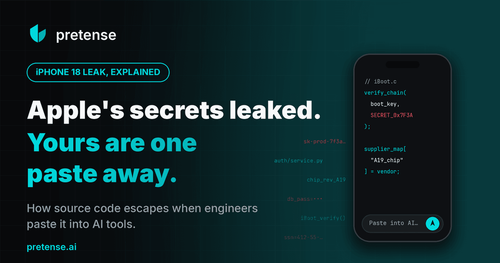
Apple iPhone 18 leaks matter far beyond gadget rumors, where the story looks like a supply chain breach. However, underneath this story is a bigger truth. You see, the most valuable code in the world leaks through people, and today, the fastest route out of any company is an engineer pasting code into an AI tool.
This post shows what actually leaked, the history of iOS source code escaping Apple, and the simple fix that keeps secrets at home while engineers keep their AI speed.
Are the iPhone 18 Leaks True?
Yes. The core facts come straight from Reuters, which reviewed the leaked documents directly.
A ransomware group called World Leaks breached Tata Electronics, one of Apple's most important manufacturing partners in India.
More than 200,000 files landed on the dark web and inside it are sensitive lists of iPhone 18 Pro components mapped to the exact suppliers who make them, details of chips on the main circuit board, battery and camera parts, and photos of iPhone 18 Pro units in drop tests, complete with Apple confidential watermarks.
Tata Breach Has Seen Files of Apple, Tesla Posted on Dark Web
CNBC's coverage confirms the same leak included component design papers for older iPhones, parts belonging to Tesla, and documents tied to TSMC and Qualcomm.
Every one of those companies trusted a partner with their secrets. But now, every one of them now shares in the fallout.
Apple guards its supplier map fiercely. The leak gives rivals, counterfeiters, and even Apple's own vendors a view of who makes what, and it reveals where Apple relies on a single supplier for a critical part, which shows bargaining leverage and vulnerability, exposed in one upload.
Now, Apple is investigating and Tata has restricted internal access and hired a forensic auditor.
One of Apple's Biggest Security Breaches Started With One Employee
If you can remember vividly, the biggest Apple leaks in history came from insiders, and each one was avoidable at the source.
The iBoot Leak (2018): Source Code for iBoot
In February 2018, someone posted the proprietary source code for iBoot to GitHub. iBoot is the part of iOS that verifies system files and boots the iPhone securely. One researcher called it the biggest leak in iPhone history.
_How did it happen? _
So, a low-level Apple employee took the code from Cupertino in 2016 and shared it with five friends in the jailbreaking community. Then it spread beyond anyone's control, and two years later the whole internet had it. The code was old, and it still gave researchers and jailbreakers a map to hunt fresh vulnerabilities in the heart of iOS.
iOS Source Code and Engineer Leaks Keep Happening
Apple is suing OpenAI, alleging a former system electrical engineer named Chang Liu exploited a rare authentication bug to keep pulling confidential files from Apple's network for weeks after he left for OpenAI.
Apple says the files held detailed information about unreleased products, engineering presentations, and technical specifications.
Recently also, Apple shipped two CLAUDE.md files from Claude Code by mistake in the Support app. These files guide AI coding tools on how to write code and manage workflows inside real production apps. The takeaway is bright and clear: even the most secretive company on earth has AI woven deep into how its engineers build software.
The pattern reaches far beyond Apple. A former IBM developer served five years in prison for stealing proprietary source code and selling it to foreign investors. That is the world every company lives in now. AI coding tools are standard equipment. The question is what travels alongside the code.
Leaked iOS Source Code in an AI Era
While the Tata breach needed a ransomware gang, the iBoot leak needed a rogue insider.
Today, sensitive source code leaves companies through a far quieter channel: engineers pasting code into AI tools as part of their normal, honest workday.
Samsung learned this in 2023, when engineers pasted proprietary chip code into ChatGPT while simply trying to fix bugs faster and the code walked out through a browser tab.
IBM's Cost of a Data Breach 2025 report found that shadow AI, meaning staff using AI tools nobody approved, adds about $670,000 to the cost of a breach. One in five breaches now involves one of those unapproved tools. And 97% of AI-related breaches happened where access controls were absent.
Traditional security tools watch email and file uploads. They were built for a different era. A senior engineer opening an AI assistant at 2am to ship a release sits completely outside their view. That prompt might carry API keys, customer records, or the kind of proprietary source code that made the iBoot leak historic. Legal finds out later, if ever.
How Pretense Keeps Source Code Safe
Pretense was built for exactly this gap. It sits on the developer's machine, like a proxy between the engineer and the AI.
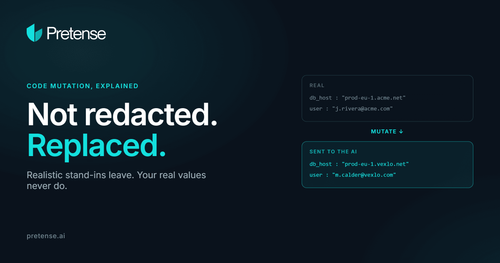
When a prompt goes out, Pretense finds the sensitive parts, the keys, the credentials, the identifying values, and swaps them for realistic stand-ins. The AI works on the safe version.
When the answer returns, Pretense restores the real values on the machine.
This is mutation, and it beats redaction. Tools that redact hand the AI blanks, and answer quality slips by 20 to 30 percent in our testing. Mutation hands the AI working code, so accuracy stays at full strength while the real secrets stay home.
Also, engineers keep their speed tight with Pretense and the setup takes about 30 seconds, free, with zero credit card required. Start free here or book a demo to walk through compliance coverage with the team.
In conclusion, the iBoot code is still out there and the Tata files are still on the dark web. However, prevention is the only move that works, and prevention happens at the moment data tries to leave. Engineers everywhere will keep using AI tools, and they should. The teams that thrive are the ones that make it safe by default. Pretense installs in 30 seconds and makes sure that when code interfaces with an AI tool, the secrets stay exactly where they belong, which is on the machine.