What Is Code Mutation?
What Is a Mutation in Code?
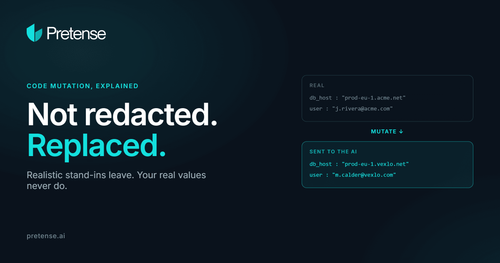
A mutation in code, in the sense used on this page, is a swap. A credential, a customer identifier, or a proprietary string gets replaced with a realistic stand-in before it leaves a developer's machine and reaches an AI tool. Once the model answers, the original values return to their place. The model only ever works with the stand-ins. The developer only sees the real values once, in the finished answer, back on their own machine.
Why This Matters
Getting this wrong carries a real cost. IBM's 2025 Cost of a Data Breach Report found that breaches involving unapproved AI tools added an extra 670,000 dollars to the average bill, a finding Pretense broke down in more detail in what shadow AI actually costs. Sensitive information reaching a model by accident is common enough that OWASP lists it as one of the top risks in its LLM Top 10.
The failure mode behind all of this is often mundane: someone pastes real code into a tool meant for something else entirely, the way an engineer at Samsung pasted proprietary chip code into ChatGPT three times in one month, with nobody in the building aware until well after the fact.
What Does "Mutate" Mean in Coding?
Outside this specific use, to mutate usually means to change something in place. An array that gets a value pushed onto it has been mutated. A record that gets a field updated has been mutated. Pretense borrows that general idea and narrows it down to one job: swapping a sensitive value for a safe stand-in on the way to a model, then swapping it back on the way out. Same verb, much narrower target.
A Worked Example
Here is a snippet of a developer's code before any of it leaves the machine:
patient_id = "MRN-2291847"
db_pass = "Pr0d!9x2k"
api_key = "sk-prod-7f3a2b9c1d"
Here is what actually reaches the model under mutation:
patient_id = "alpha_record"
db_pass = "sandbox_pw_44"
api_key = "sk-demo-beta7719"
The structure holds. The data types hold. The shape of the problem holds. The model reasons about the mutated version the same way it would the original, and when it hands back a fix or a suggestion, Pretense reverses the swap on the return trip. The developer's answer shows the real values again. Those real values only ever traveled as far as the developer's own machine.
Credentials and API keys like these are common enough targets that they get a closer look in how to prevent credentials and API keys from leaking in AI tools. They turn up constantly in the wild too: GitGuardian's 2026 secrets sprawl report counted close to 29 million newly exposed hardcoded secrets on public GitHub in a single year, a 34 percent jump from the year before.
Code Mutation vs. Redaction
| Mutation | Redaction | |
|---|---|---|
| What the model sees | A realistic stand-in value | A blank or placeholder |
| Context preserved | Yes | Lost |
| Typical effect on accuracy | Held, based on Pretense's internal testing | Degraded by roughly 20 to 30 percent over a few prompts, in that same testing |
Redaction strips a sensitive value out entirely, leaving something like patient_id = [REDACTED]. A blank leaves the model to guess at a value's shape, and the guesses compound as a conversation runs on. That is the pattern Pretense saw testing both approaches side by side.
Why Answer Quality Holds
Reasoning correctly about a query, a bug fix, or a test case only requires a value of the right shape and type. Whether patient_id used to hold MRN-2291847 is irrelevant to that reasoning; the model just needs something plausible to work with. Mutation supplies exactly that. Redaction leaves a gap where a value used to sit, and every model handles a plausible stand-in better than it handles a gap.
This is the case for mutation over blocking or stripping: security and accuracy hold together here, provided the substitution is done well.
Where Mutation Runs
For mutation to work, it has to happen locally, on the developer's own machine, before a prompt goes anywhere. If the swap happened on a server after the data had already left the machine, the sensitive value would have already been exposed in transit, which defeats the entire point. This is why tools built this way, Pretense included, run as a local proxy rather than a cloud service. The real values are meant to stay on the device from the start.
Not the Same as Mutation Testing
Mutation testing is a separate, well-established idea in software quality assurance, and the overlap in vocabulary is worth clearing up. Teams use it to check how thorough a test suite really is. A tool introduces small, deliberate bugs into a copy of the code, called mutants: flipping a comparison operator, say, or changing a returned value. The existing tests run against that altered copy. A test that fails has killed the mutant, meaning the suite caught the change. A test that still passes means the mutant survived, which points to a hole in coverage. The mutation score is the share of mutants killed out of the total introduced, and tools such as PITest and Stryker automate the whole cycle for teams running mutation testing software at scale.
This is a different discipline from what this page covers. Pretense's mutation is a data protection technique, applied to live values heading toward an AI model. Mutation testing is a code quality technique, applied to a copy of source code heading toward a test runner. The two share a name and little else.
FAQ
Is code mutation the same as mutation testing? They are unrelated ideas that happen to share a name. Code mutation protects data heading toward an AI model. Mutation testing checks whether a test suite catches deliberately introduced bugs. Same word, different fields.
What kind of values does Pretense mutate most often? Credentials, customer identifiers such as SSNs or patient IDs, and proprietary strings pulled straight from source code account for most of what gets swapped day to day.
Why call it mutation instead of masking or tokenization? Masking and tokenization usually swap a value for a fixed placeholder or a reversible token stored in a vault somewhere. Mutation swaps a value for something the model can reason about as if it were real, then reverses that swap locally once the response comes back. The mechanics differ enough that a separate term earned its place.
For a broader look at securing AI coding tools across a team, see the CISO guide to AI coding tools.