AI coding tools went from a novelty to a daily habit fast. Most engineers now open Copilot, Cursor, or Claude Code the way they open a terminal. The one thing worth adding is a small guardrail so secrets stay home while the AI does its job.
The truth is, source code, API keys, and customer records can slip out inside an ordinary prompt.
The good news is that the fix is small, it fits the way teams already work, and it pays for itself fast. Pretense adds that guardrail right on the laptop, and a team can start free in about 30 seconds.
So let us walk through how code leaks to AI tools, what it costs, and the calm way to lock it down.
How to Use AI Coding Tools Without Leaking Source Code
The trick is simple. You can keep using the tools and add one quiet layer.
That layer hides sensitive values before a prompt leaves the machine, so the AI still gets working code and the secrets stay put.
Here is the simple flow on how to prevent AI data leakage:
- -
Swap the sensitive parts for realistic stand-ins on the machine
- -
Let the model answer,
- -
Then put the real values back in the reply.
This way, developers keep their flow, and security teams get a clean record of what left and what stayed. That is exactly how Pretense works.
To see why the risk hides so well, it helps to know what these tools send in the first place.
What Your Coding Tools Actually Send
Every popular assistant runs its model in a datacenter, so it has to send some context out to do its job.
GitHub Copilot sends the file in focus, nearby open files, the language it detects, and the cursor position to build each suggestion.
Cursor, being an AI-first editor, sends the active file, the project layout, and terminal output, and it offers a Privacy Mode that keeps code out of training while the code still passes through its servers.
Claude Code reads and sends whatever it is pointed at: files, git diffs, folder listings, and terminal output. All of this is normal, and all of it is by design.
Picture a test file that holds a real database link, or a config file that fills in with a live password. Ask an assistant to tidy it up, and that value rides along inside the request. That is the whole gap.
A password, a patient record, or a private function can sit inside everyday context and travel with it. A local hiding layer closes that gap while the tools keep working at full strength.
And the reason this matters more every month is simple: almost everyone is using these tools now.
The Explosion of Generative AI and Copilot Adoption
Adoption is a real win for shipping speed. About 84% of developers now use or plan to use AI coding tools, up from 76% a year earlier, and 51% of pros reach for them every day, per Stack Overflow's 2025 Developer Survey. GitHub Copilot has passed 20 million users and runs inside roughly 90% of the Fortune 100, while Cursor and Claude Code keep climbing.
More people means more prompts, and more prompts means more chances for a secret to travel. Look at it the bright way, though. The same growth that speeds up delivery also raises the payoff of one clean guardrail. Set the hiding layer once, and every prompt after that goes out safe by default.
That payoff gets clearer once the hidden risk comes into view.
Why AI Tools Pose Hidden Data Leak Risks
Most security tools watch email and file uploads. Source code tends to leave through a different door: a browser tab, or an API call from a coding tool. That door stayed open while the walls went up everywhere else, which is why the risk sat in plain sight for so long.
The numbers tell the story, and they point straight at the fix. In IBM's 2025 research, 1 in 5 breached companies traced the trouble to shadow AI, the tools staff pick up on their own. Those breaches added about $670,000 to the average cost, and 97% of AI-related breaches happened where access controls were missing, per IBM's Cost of a Data Breach 2025. Flip that around and it turns into good news: put a control in place, and the priciest kind of failure mostly goes away.
If a leak feels like something that only happens to careless teams, the next story clears that up quick.
Claude AI Source Code Leak
Even a safety-first AI lab watched its own code slip out through a channel it barely watched, which shows how easily code can travel and why a guardrail that runs by default helps every team.
On March 31, 2026, Anthropic accidentally shared the source of Claude Code through a stray map file included in its public npm package. That file pointed to roughly 512,000 lines of TypeScript across about 1,900 files, and copies spread across GitHub within hours.
Anthropic called it a release packaging slip caused by human error rather than a security breach, and confirmed that customer data and credentials stayed safe. The reporting is available at TechRadar.
There are two lessons to learn from this:
• First, code leaves through channels teams rarely watch, so a guardrail that runs on its own beats hoping the channel stays shut.
• Second, the copycat repos that claim to hold the leaked code have carried malware in some cases, so the safe move is to treat any such repo as off-limits and lean on official sources only.
Code leaking out is the big one, and a few cousins are worth a quick look too.
How do you prevent credential leaks to AI tools?
Credential leaks reach AI tools mostly through everyday habits, so the answer is a small set of habits and guardrails that run quietly in the background. Four moves cover the ground, and together they keep keys, tokens, and customer data home while the AI keeps working at full strength.
1. Add AI-aware DLP and prompt scanning
Human error sits behind most leaks, so the first layer scans prompts and file uploads in real time, right as they head toward a public AI tool. Enterprise DLP platforms such as Microsoft Purview and Cloudflare cover this category, catching confidential text and long random-looking strings like API keys and tokens on the way out. The part that really matters is the method. Where classic DLP blocks or blanks out a match, Pretense swaps it for a realistic stand-in, so the model still gets working context and the answers stay sharp. That one change turns a hard block into a smooth, protected prompt.
2. Sanitize AI-generated code
AI coding assistants like GitHub Copilot and Cursor sometimes drop a credential or a .env value straight into their output, so a quick review keeps that value out of the codebase. Two habits make it reliable:
- -Scan AI-generated code for common secret shapes such as
sk-,AKIA, andghp_before it ships. - -Run secret scanning in the CI/CD pipeline so any commit carrying a live credential gets caught at the door. GitHub push protection blocks hardcoded secrets before they reach a repository, which makes this close to automatic.
Pretense adds to this by hiding secrets on the way to the model in the first place, so the assistant works from safe values and has far less chance to echo a real one back.
3. Tighten access controls and secrets management
Treat AI integrations and agents like teammates with a clear job description, and give each one only the access its role calls for. Three practices carry most of the weight:
- -Apply least privilege so an AI tool reaches only the databases and files its task truly needs.
- -Swap long-lived API keys for short-lived, just-in-time credentials, so a leaked key stays useful for only a few minutes.
- -Keep secrets in a dedicated secrets manager, held apart from code repositories, so the raw values live in one guarded place.
These controls limit the damage if anything slips, and Pretense adds the layer that keeps those same secrets home even inside a prompt.
4. Choose enterprise AI tiers and private deployments
Business and enterprise tiers of the major AI tools keep prompts and data out of model training by default, which takes the training worry off the table. For teams that want their data to stay fully inside their own cloud, private deployments such as Azure OpenAI run in a controlled tenant, where prompts, completions, and embeddings stay isolated and apart from the base models.
Here is the honest and cheerful part. Even on those tiers, the raw secret still travels from the laptop to the provider. Pretense keeps that raw value home by hiding it locally first, so the enterprise tier handles training and residency while Pretense guards the secret itself. Together they give full coverage.
All of these steps point to one simple idea, and that idea is exactly what Pretense was built to deliver.
Pretense Approach to AI Security and Governance
Pretense sits between developers and the AI, like a proxy on the machine.
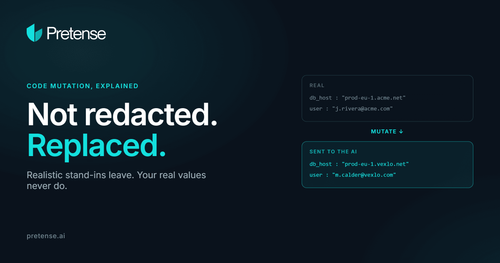
When code goes out, it finds the sensitive parts and swaps them for realistic stand-ins. The model works on the safe version. When the answer comes back, Pretense puts the real values back in place, right on the laptop. The real secrets stay home the whole time.
This is mutation, and it beats plain redaction on quality. Redaction strips fields out, so the model loses the thread and its answers drift lower with each prompt.
Mutation swaps instead, so the model sees complete, working code and holds full accuracy at the same speed. Security becomes part of the chat with the AI instead of a bolt-on added later. And governance comes built in: dashboards for live activity, top users and repos, and an audit trail, with SOC 2 and HIPAA support on the roadmap.
How does Pretense prevent AI data leakage?
Pretense hides sensitive values on the machine before any prompt reaches a model, then puts them back in the reply. Passwords, keys, patient records, and private source all get realistic stand-ins on the way out and the real values on the way back. Because the swap happens on the machine, the true data stays put, and the team gets a record of exactly what traveled.
But then, how do you safely fix code with AI using Pretense?
Well, the flow feels the same as normal coding, with one quiet layer added. Keep working as usual and ask the AI to fix the bug. Pretense swaps the secrets for stand-ins before the prompt leaves the laptop.
The model sends back a fix built on the safe version. Pretense puts the real values back in place, and the fix drops into the codebase clean.
Getting started takes about 30 seconds and zero paperwork. Install the CLI, create an organization, generate an API key, and start coding. Start free today, book a walkthrough with the team, or watch a 2-minute demo. Plan details sit on the pricing page, and the docs cover setup end to end.
AI coding is here to stay, and that is a good thing for every team that ships. Add one local guardrail, and the upside stays while the secrets stay home. Get started free with Pretense and protect the next prompt before it travels.
Other AI Security Risks
Code exposure is the headline, and a few neighbors deserve a spot on the radar. Prompt injection, ranked the top risk in OWASP's 2025 list for LLM applications, lets hidden instructions take over an assistant through a poisoned file or web page. AI-generated code can carry quiet bugs, so a review still matters. The software supply chain now includes bad packages and fake "leak" repos, so checking sources counts for more each month.
One more item shares the name but means something else. The phrase "how to avoid data leakage in machine learning" points to a modeling problem, where information from the test set sneaks into training and makes the results look better than they really are. The fix there is clean separation: split the data before any feature work, keep target-based fields out of the inputs, and test on data the model has truly earned the right to see. Same words, different craft, and both reward tidy habits.
Knowing the risks is half the job. The other half is a simple plan that keeps them in check.