In July 2026, a security researcher caught Grok Build, the AI coding CLI from Elon Musk's xAI, quietly uploading developers' entire local Git repositories to its own cloud.
Sam Altman, the CEO of OpenAI, summed up the industry reaction in one public word: "Concerning."
In this blog post, we will show you what happened, why open source AI harnesses and self-hosted AI infrastructure suddenly dominate every enterprise AI conversation, and a practical way businesses can prevent AI providers from accessing proprietary data while keeping their AI speed.
What Happened: Grok Build and the 27,800x Data Gap
The researcher, who publishes as cereblab, ran Grok Build through a proxy and captured everything the tool sent home. The Hacker News covered the findings in detail, and developers have been arguing about AI cloud security ever since.
The numbers explain why. On a 12 GB test repository, the AI model needed about 192 KB of traffic to do its job. The separate storage channel moved 5.10 GiB to an xAI-run Google Cloud bucket. That works out to a 27,800x gap between what the AI inference required and what actually left the machine. And because the upload carried the full Git history, secrets committed years ago and deleted since went along for the ride. The researcher even pulled back a file the AI agent had been told, in plain terms, to leave alone.
TechTimes reported that the "Improve the model" toggle controlled training permission only. Data transmission ran on a separate track, whatever users chose.
Jimmy Malhan, Pretense's AI CEO, described what that meant in practice in a LinkedIn post:
"There was a toggle for this, and it said 'Improve the model.' You would turn it off and assume your code was staying home, but it kept getting uploaded anyway. What finally stopped it was a switch xAI flipped on their own servers a day after the researcher caught it, and they never told the people who were using the tool."
That server-side flag remains the only thing standing between developer codebases and that cloud bucket. The upload code still lives inside the current binary.
When the findings spread across X, Sam Altman replied publicly:
"Concerning. A reason to favor open-source harnesses."
Imagine now, the head of one of the biggest AI model providers on earth is pointing at open source AI harnesses as the trust answer. You see, when the people who build foundation models urge caution about the tooling wrapped around foundation models, CTOs tend to listen.
Foundation Models vs Managed AI Platforms: The Harness Question
So what exactly is a harness? An AI harness is the layer between a raw AI model and the user: the CLI, the agent framework, the AI platform piece that manages context and telemetry. While the model answer questions, the harness decides what data reaches it.
Now, the Grok Build incident proved the harness can behave very differently from the model it wraps, and that gap is where the risk lives. The distinction is already driving product decisions across AI startups.
In another LinkedIn post, Harsha Vankayalapati, co-founder of AgentWeb explained why his team built a custom, isolated harness for AgentWeb, and why their assistant, Emma AI, runs on raw foundation models while bypassing managed harnesses entirely. Part of his reasoning was plain AI competition: hand a model provider a full view of an AI app's data and behavior, and that provider can spin up a rival version with remarkable ease.
His other point was about money. A lot of AI startups subsidize margins with free credits from AI model providers, and those credits come with data gravity attached. His team charges real prices and works on AI inference cost optimization instead, keeping proprietary data in their own control. Security, as he put it, is becoming the real moat as the AI arena scales.
The Pattern Underneath: AI Workflow Security Is the Gap
Just the same way Grok Build uploaded developers' entire local Git repositories to its own cloud, Samsung engineers pasted proprietary chip code into ChatGPT in 2023. The Tata Electronics breach put Apple's iPhone 18 supplier maps on the dark web last month. And now an AI coding tool shipped whole codebases upstream by design. The incidents look different, but the data left the same way each time: through an AI tool.
In each case the data left through the AI workflow itself, a channel traditional security was blind to. That blind spot is why AI cybersecurity and LLM security have turned into their own discipline rather than a footnote in the DLP manual.
Jimmy Malhan used to be one of those developers sneaking around security tools himself, when he said:
"I've been the developer blocked by the tools at work and using my own account to get things done, because a deadline doesn't care about your security policy. So I know how this plays out. You trust the setting, but the setting isn't the thing that decides what leaves your machine."
AI Data Privacy for Businesses: Three Paths Forward
Enterprises have three broad responses on the table, and they solve different parts of the problem.
- -
Path one: self-hosted AI infrastructure: Running open source AI models on owned hardware gives maximum AI data control for enterprises. The tradeoff is cost, talent, and giving up frontier model quality. A small set of companies with deep pockets can pull this off. Most will struggle.
- -
Path two: open source AI harnesses: Following Sam Altman's suggestion, teams can pair top foundation models from providers like Anthropic and OpenAI with transparent, auditable harnesses. This fixes the hidden-telemetry problem, and it fixes it well. The prompt itself, though, and every secret inside it, still travels to the AI cloud.
- -
Path three: protect the data before it travels: This is the layer both other paths skip, and it is where AI infrastructure security gets practical for ordinary teams. Whatever harness, whatever AI API, whatever AI model provider a team picks, the move that holds up is making sure sensitive values are already safe by the time any prompt leaves the laptop.
How to Protect AI Application Data: The Pretense Approach
That third path is the reason Pretense exists.
"That's why I built Pretense," Malhan wrote.
"It runs on your computer, in between you and the AI, and before anything goes out it swaps your real secrets for fake ones that still look real. If Grok had grabbed a repo that ran through Pretense first, everything it carried to the cloud would have been fake."
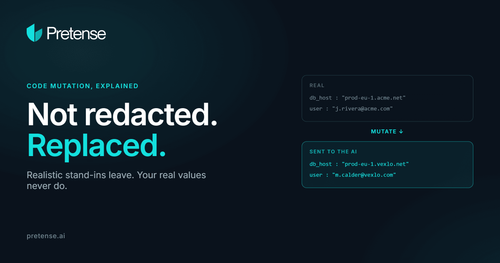
Here is how Pretense works. Pretense sits on the developer's machine, between the engineer and every AI tool they use. When code goes out, it finds the sensitive parts, the API keys, credentials, customer identifiers, proprietary values, and swaps them for realistic stand-ins. The AI works on the safe version. When the response returns, Pretense restores the real values locally.
Now replay the Grok Build incident with Pretense in place. A harness scoops up files and ships them upstream. What lands in that cloud bucket? Stand-ins. The canary credentials that appeared verbatim in the researcher's capture would have been decoys. The blast radius of the whole incident collapses to nearly zero, because the real secrets stayed home the entire time.
Mutation: AI Codebase Security That Preserves Answer Quality
The approach is called mutation, and quality is where it beats redaction. Redaction hands the AI blanks, and in our testing answer accuracy slips by 20 to 30 percent as the context disappears. Mutation hands the AI realistic, working code, so quality holds at full strength.
AI app development teams should care about this more than any other spec, because a secure AI deployment that slows engineers down gets bypassed within a week. Every security lead has watched that movie.
Secure AI Deployment in About 30 Seconds
Pretense installs with one command on macOS and Linux, works across Claude, GPT, and Gemini, runs local-first, and starts free with zero credit card. It fits any AI workflow, from solo founders to enterprise AI teams building toward SOC 2. Start free here or book a demo to walk through AI governance and audit trails with the team. Prefer to see it first? Watch a 2-minute video of the swap happening in a live codebase.
FAQs:
How can businesses prevent AI providers from accessing proprietary data?
Substitute sensitive values before prompts leave the machine. Mutation-based tools like Pretense make this automatic, so proprietary data stays local while AI tools receive realistic stand-ins and keep working at full quality.
Are open source AI harnesses safer than managed platforms?
They are more transparent, since anyone can audit what the code sends home, and that transparency is worth a lot. Pair them with data protection at the prompt layer for full coverage, because even a fully audited harness still transmits prompt contents to the AI model provider.
Is self-hosted AI infrastructure right for my team?
It offers maximum control and suits regulated giants with strong platform teams. Most companies get further, faster, by combining frontier foundation models with local data protection, which keeps both quality and AI data security high.
What should developers who used Grok Build do right now?
Rotate every credential the tool could have touched, including secrets that lived anywhere in Git history. Then adopt a protection layer so the next incident finds stand-ins instead of real keys.
What is an AI harness, in plain terms?
It is the software wrapper around an AI model: the CLI or agent that manages files, context, and tool calls. The model answers questions. The harness decides what data reaches it, which is exactly why the harness belongs at the center of any AI security review.