
4,500 Private Conversations, Fully Searchable
In July 2025, security researchers discovered that over 4,500 private ChatGPT conversations shared via OpenAI's "Share" feature had been indexed by Google and Bing. The cause was mundane -- a missing noindex meta tag on shared conversation pages. The impact was anything but mundane.
The exposed conversations included therapy session notes, legal strategy discussions, business plans with financial projections, proprietary code with detailed comments, and medical symptom descriptions with identifying details. All of it was fully searchable, cached by search engines, and accessible to anyone with a browser.
This was not a sophisticated hack. It was not a zero-day exploit. It was a configuration error on a feature that millions of people use every day. And it exposed one of the fundamental risks of sending sensitive data to cloud AI services: once your data is on someone else's infrastructure, you have no control over how it is stored, cached, indexed, or exposed.
What Was Actually Leaked
The 4,500+ conversations covered a wide range of sensitive content:
- -Legal advice: Attorney-client discussions about pending litigation, including case strategy and settlement figures
- -Medical information: Detailed symptom descriptions with enough context to identify patients
- -Business strategy: Go-to-market plans, competitive analysis, pricing models, and financial projections
- -Source code: Complete functions and classes with proprietary variable names, business logic, and architecture decisions
- -Personal data: Names, addresses, phone numbers, and email addresses embedded in conversations
For developers specifically, the risk was acute. When a developer shares a ChatGPT conversation with a colleague ("here is how I fixed that bug"), the shared link now contains the full conversation history -- including every code snippet pasted into the chat.
The Developer-Specific Risk
Consider a typical debugging session. A developer pastes a function into ChatGPT, asks for help, iterates on the solution, and then shares the conversation with a teammate. That shared link now contains:
// Actual conversation content (before Pretense)
// Developer: "This function is throwing a null pointer. Can you help?"

async function processPaymentWebhook(event: StripeWebhookEvent) {
  const customer = await CustomerRepository.findByStripeId(
    event.data.object.customer
  );

  if (customer.subscriptionTier === 'enterprise') {
    await EnterpriseBillingEngine.processInvoice({
      customerId: customer.id,
      amount: event.data.object.amount_paid,
      planId: customer.currentPlan.id,
      discountCode: customer.negotiatedDiscount?.code,
    });
  }

  await AuditLogger.record({
    action: 'payment_processed',
    customerId: customer.id,
    amount: event.data.object.amount_paid,
    source: 'stripe_webhook',
  });
}
This single code snippet, now indexed by Google, reveals: the payment provider (Stripe), the billing architecture (enterprise tier with negotiated discounts), the data model (customer has subscriptionTier, currentPlan, negotiatedDiscount), and the audit logging approach. A competitor searching for your company name plus "ChatGPT" could find this conversation and reconstruct your billing architecture.
How Pretense Would Have Made This Leak Harmless
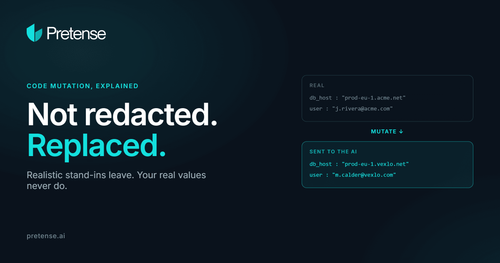
If the developer had been using Pretense, the conversation stored on OpenAI's servers -- and subsequently indexed by Google -- would have contained only synthetic identifiers:
// What ChatGPT would have stored (after Pretense mutation)
// The conversation Google indexed would show this:

async function _fn4a2b(_v3b1c: _cls7d4e) {
  const _v8a2f = await _cls1e5f._fn2c3d(
    _v3b1c.data.object.customer
  );

  if (_v8a2f._v9d8e === 'enterprise') {
    await _cls6a7b._fn5e6f({
      customerId: _v8a2f.id,
      amount: _v3b1c.data.object.amount_paid,
      planId: _v8a2f._v4f5a._v7b8c,
      discountCode: _v8a2f._v2d3e?.code,
    });
  }

  await _cls3c4d._fn8c9d({
    action: 'payment_processed',
    customerId: _v8a2f.id,
    amount: _v3b1c.data.object.amount_paid,
    source: 'stripe_webhook',
  });
}
A competitor finding this on Google sees: a function that processes some kind of event, checks a condition, calls some methods, and logs something. They cannot determine the payment provider, the billing model, the data schema, or the business logic. The synthetic identifiers are meaningless without the mutation map, which never left the developer's machine.
The Key Insight
The ChatGPT privacy leak demonstrates a category of risk that no access control or privacy policy can address: unintended exposure through third-party platform features. You cannot predict every way a cloud service might expose your data -- through sharing features, caching layers, CDN misconfigurations, backup systems, or search engine crawlers.
The only defense that works against unpredictable exposure vectors is to ensure the data itself is not sensitive. That is exactly what mutation does. It transforms your proprietary identifiers into synthetic tokens before they reach any third-party infrastructure. No matter how the data is subsequently exposed -- through sharing links, search engine indexing, data breaches, or employee screenshots -- the exposed content does not contain your real code.
The Broader Pattern: Platform Risk
The ChatGPT indexing incident is part of a broader pattern of AI platform security failures:
- -January 2025: ChatGPT bug exposed conversation histories from other users
- -March 2025: Bing Chat cached conversation transcripts were accessible via URL enumeration
- -July 2025: 4,500+ shared conversations indexed by search engines
- -September 2025: ChatGPT plugin data exposed through API misconfiguration
Each incident has the same root cause: when your data lives on someone else's infrastructure, you inherit their security posture. Their bugs become your data breaches. Their configuration errors become your compliance violations.
Enterprise security teams have spent decades learning this lesson with cloud infrastructure. The same lesson applies to AI tools, but the stakes are higher because AI conversations contain concentrated intellectual property -- not just routine data, but the specific code and reasoning that represents your competitive advantage.
What To Do Right Now
If your team uses ChatGPT, Claude, Copilot, or any other AI coding tool, you should assume that conversation data may be exposed through platform vulnerabilities you cannot predict. The mitigation is straightforward:
- -Install Pretense to mutate code identifiers before they reach any AI API
- -Disable sharing features on AI tools where possible
- -Audit existing shared links for sensitive content
- -Establish a policy that all AI coding interactions go through the Pretense proxy
# Protect all AI interactions in 30 seconds
curl -fsSL https://pretense.ai/install.sh | sh
pretense init
pretense start

# Route Claude through Pretense
export ANTHROPIC_BASE_URL=http://localhost:9339
The 4,500 conversations indexed by Google are a warning. The next platform vulnerability might expose 45,000 conversations, or 450,000. Mutation ensures that no matter how many conversations are exposed, your proprietary code remains protected.
Protect Your Code Today
Pretense is the AI firewall that mutates proprietary code before it reaches any LLM API. Install in 30 seconds and protect your team's intellectual property.
curl -fsSL https://pretense.ai/install.sh | sh
pretense init
pretense start